17 August 2026
Weather Monitoring for Overhead Transmission Lines
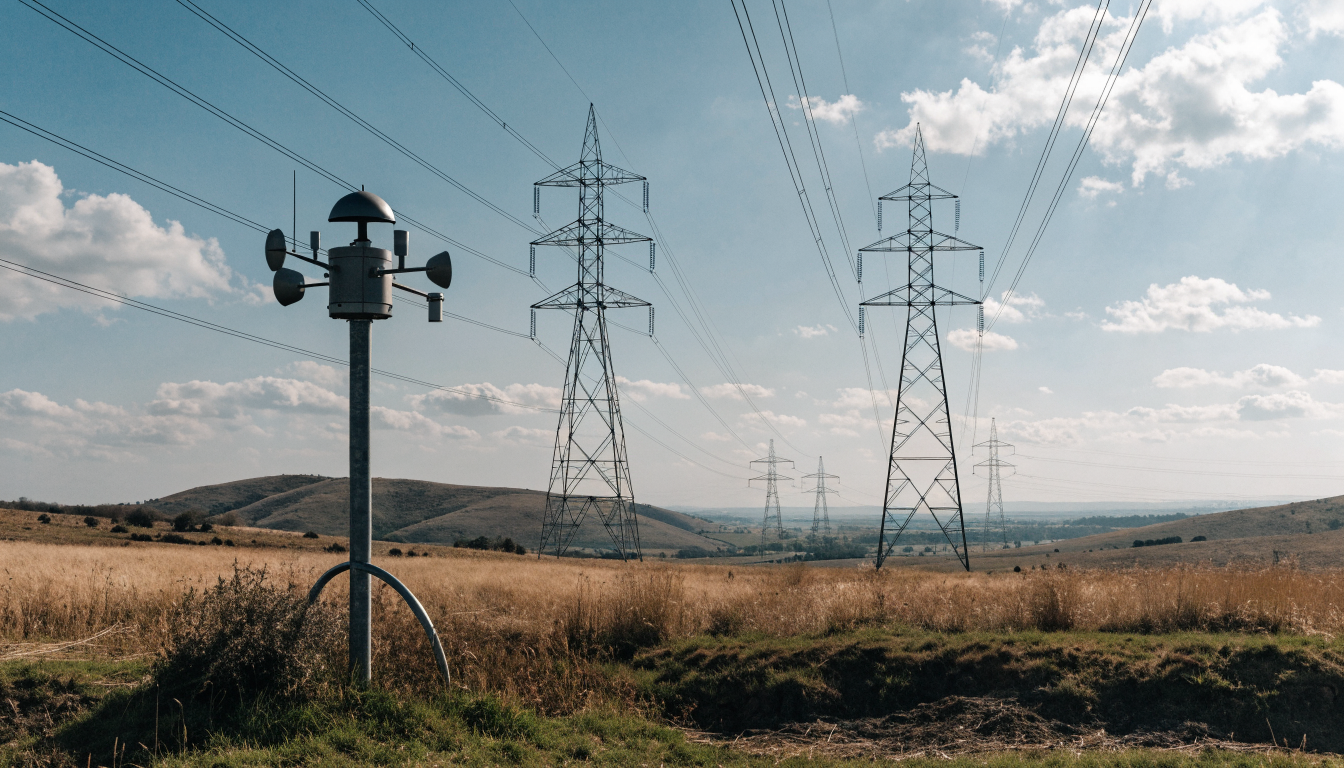
Key takeaways
- Overhead transmission lines run through varied terrain, so a single regional forecast is not enough to manage local weather risk along the route.
- Compact, integrated weather sensors combining ultrasonic wind measurement and piezoelectric rain detection can be installed on pylons in minutes, with no moving parts to service.
- Data is normally sent over RS485, RS232, WiFi, Bluetooth or LTE back to a control centre, so operators get real-time alerts rather than periodic manual readings.
- MetSensor UK supplies the ZTLS overhead transmission line weather station and the underlying ZWS series sensors used for this kind of monitoring in the UK.
Why transmission lines need dedicated weather monitoring
Overhead power lines often run for many kilometres across hills, valleys, river crossings and open moorland. Each of these locations can have its own microclimate. A pylon on a hilltop may see far higher wind loading than one in a sheltered valley only a few miles away. Relying on a single weather station at a substation, or on regional forecast data, leaves gaps in what the network operator actually knows about conditions at each tower. Wind loading, ice accretion and lightning risk all change the mechanical stress on conductors and towers, so operators benefit from measuring conditions at multiple points along a route rather than at one central location.
What parameters matter for line monitoring
For transmission line applications, the parameters that matter most are wind speed and wind direction, air temperature, relative humidity, barometric pressure, rainfall and solar radiation. Wind speed and direction affect conductor galloping and mechanical load on towers. Temperature affects conductor sag, since metal conductors expand and sag further in heat and contract in cold. Rainfall and humidity are relevant to insulator performance and to storm tracking. Solar radiation readings support thermal rating calculations for the line, since a conductor's safe current-carrying capacity depends partly on ambient heating from the sun.
Sensor technology used on transmission routes
Modern compact weather sensors for this application typically use ultrasonic technology to measure wind rather than a mechanical cup-and-vane anemometer. An ultrasonic sensor has no moving parts, so it does not wear out through bearing friction and keeps working in icy conditions that would jam a mechanical cup anemometer. You can read more about the practical differences between the two approaches in our guide to ultrasonic versus cup anemometers.
Rainfall is commonly measured with a piezoelectric sensor rather than a traditional tipping-bucket gauge. A piezoelectric rain sensor detects the impact of raindrops directly and has no bucket mechanism to jam with debris or freeze in cold weather, which matters on remote towers that are rarely visited.
Compact, all-in-one sensor units
Rather than mounting six or seven separate instruments on a tower, transmission line projects increasingly use a single compact sensor unit that combines wind speed, wind direction, temperature, humidity, pressure and rainfall measurement in one housing. This reduces the number of cables, brackets and connection points on the structure, which matters when access for installation and maintenance is difficult. Units in the ZWS series are designed for exactly this kind of consolidated mounting, and a dedicated ZWS200 ultrasonic anemometer is available where wind measurement alone is needed alongside existing sensors.
Power and communication for remote towers
Transmission towers are frequently far from mains power, so weather sensors for this application are usually run from a DC 12V or 24V supply fed by a small solar panel and battery, keeping the installation self-sufficient. On the communication side, the sensors typically support RS485 and RS232 for wired connection into existing supervisory control and data acquisition (SCADA) infrastructure, alongside WiFi, Bluetooth and LTE options for wireless transmission where no cable route exists. RS485 with Modbus RTU is the most common wired protocol in this kind of installation. Our explainer on RS485 and Modbus covers how that protocol works if you are specifying a new monitoring network.
Installation and maintenance considerations
One practical advantage of an integrated sensor over a set of separate mechanical instruments is installation time. A single compact unit with no moving parts can usually be mounted and wired within minutes, compared with a longer process for assembling and calibrating multiple mechanical sensors on site. Because there are no bearings, cups or tipping mechanisms to wear out, these sensors are generally rated for several years of service without routine manual maintenance, which is significant for towers that may only be accessed once or twice a year.
Typical deployment points along a route
Weather monitoring points are usually placed where local conditions are expected to differ most from the surrounding area, for example at high-elevation towers, river or valley crossings, and any section of the route flagged in the original geotechnical or environmental survey as having an unusual microclimate. National grid operators building out weather-aware transmission networks tend to combine data from these points with central forecasting so that maintenance crews and control room staff receive early alerts on high-wind or icing risk before it becomes an operational problem.
How this fits into a wider grid monitoring strategy
Weather data from towers is only useful if it reaches the control centre reliably. Because most compact transmission-line sensors output digital data over RS485 or a wireless link, they integrate directly into existing SCADA and asset-monitoring platforms without needing custom interfacing. This lets network operators combine live weather readings with conductor temperature models, line rating calculations and storm-tracking tools in one system, rather than treating weather as a separate data source checked manually.
MetSensor UK is a UK-based supplier of our manufacturing partner environmental sensors, including the compact weather sensors and ultrasonic anemometers used in transmission line monitoring. If you are specifying instrumentation for a UK network project, our weather sensors range and weather stations range list the current models available for UK delivery.
Frequently asked questions
Why not just use one weather station per substation instead of monitoring individual towers?+
Terrain along a transmission route can vary a lot over short distances. A hilltop tower can see much higher wind loading than a tower in a sheltered valley a few miles away, so a single substation reading does not represent conditions at every tower.
Why is ultrasonic wind measurement preferred over a cup anemometer for this application?+
Ultrasonic sensors have no moving parts, so they are not affected by bearing wear and continue to work in icing conditions that can jam a mechanical cup anemometer.
How is power usually supplied to a weather sensor on a remote pylon?+
Most installations run from a DC 12V or 24V supply fed by a small solar panel and battery, since mains power is rarely available at tower locations.