26 September 2026
SODAR Wind Profiler Systems Explained
Key takeaways
- SODAR stands for sonic detection and ranging, a remote-sensing method that measures wind at multiple heights by tracking the Doppler shift of sound waves scattered by atmospheric turbulence.
- A typical SODAR unit can profile wind from around 10 m up to 200 m in height, in vertical steps of about 10 m, without needing a mast at every measurement level.
- Horizontal wind speed accuracy is typically around 0.3 m/s or 3% of the reading, with wind direction accuracy of about 3° above 5 m/s wind speed.
- MetSensor UK supplies the ZAS Doppler SODAR wind profiler for wind resource and aviation monitoring in the UK.
What SODAR measures and why it exists
A SODAR system is a ground-based instrument that profiles wind speed and direction at multiple heights above the ground without requiring a physical mast at each height. This matters because building and instrumenting a tall meteorological mast is expensive and, above certain heights, impractical. SODAR gives a way to measure wind through a column of air using acoustic remote sensing instead, making it useful anywhere a vertical wind profile is needed but a mast is not a realistic option.
How SODAR works
A SODAR unit transmits short pulses of sound at multiple frequencies upward into the atmosphere using a phased array of transducers. When these sound pulses hit pockets of atmospheric turbulence, some of the acoustic energy scatters back down to the ground and is picked up by the same array acting as a receiver. Turbulence moving with the wind shifts the frequency of the returned sound through the Doppler effect, in the same way a passing ambulance siren changes pitch. By measuring this frequency shift, the system calculates the radial wind speed at the height the pulse reached before scattering back. Because the system knows how long each pulse took to return, it can assign each measurement to a specific altitude, building up a profile through the atmospheric column.
System components
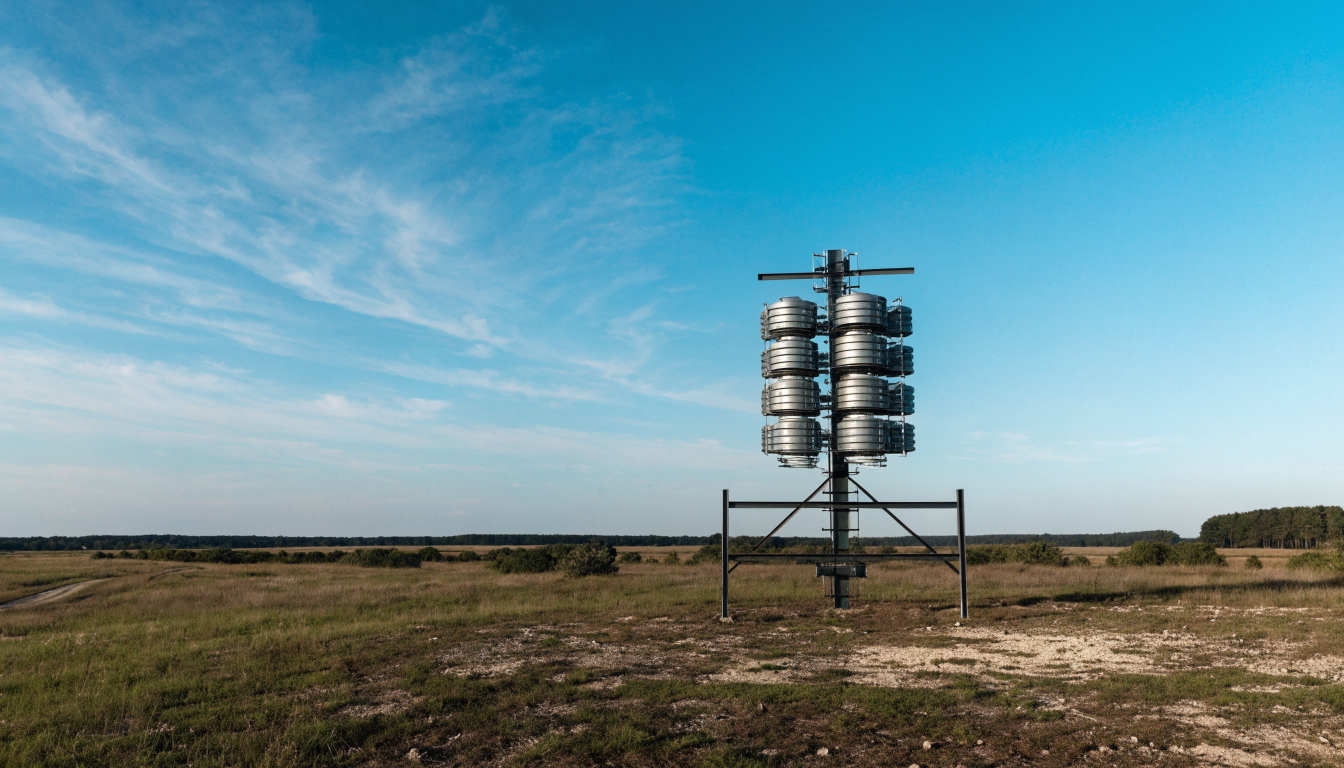
A SODAR unit generally consists of a phased array antenna with an integrated signal generator, an acoustic power amplifier to drive the transducers, a signal receiving and processing unit, and a fixed mounting base. In a system like the ZAS SODAR wind profiler, the antenna array can contain around 64 individual piezoelectric transducers operating across six working frequency points, which improves the ability to separate real atmospheric returns from noise and interference at any single frequency.
Typical performance figures
Under favourable conditions, roughly 40 dBA ambient noise, 15°C and 70% relative humidity, a SODAR unit can resolve up to around 20 distinct height layers, with a vertical resolution of about 10 m or better between layers, across a measurement range of roughly 10 m to 200 m. Horizontal wind speed is typically measured across a 0 to 30 m/s range with an accuracy of around 0.3 m/s or 3% of the reading, whichever is larger. Vertical wind speed, useful for detecting updrafts and downdrafts, is typically measured across roughly -7 to +7 m/s with an accuracy near 0.5 m/s. Wind direction accuracy is typically around 3° once wind speed exceeds about 5 m/s, since very light winds are harder to resolve directionally with any remote sensing method. A single measurement cycle to build a full profile typically takes between one and ten minutes depending on atmospheric conditions.
Physical and electrical characteristics
A compact SODAR unit like the ZAS weighs under 15 kg and measures roughly 50 cm by 50 cm by 27 cm including its radome, making it feasible to mount on a trailer, rooftop or small ground platform rather than requiring a dedicated mast structure. Power consumption peaks at around 2A on a 24V DC supply, and the unit is typically rated for operation across a wide temperature range, roughly -40°C to +80°C, supporting deployment in both cold and hot climates. Data is normally output over RS485, LAN, GPRS or WiFi, with an optional GPS module for automatic location tagging where the unit may be relocated between sites.
Limitations from precipitation and noise
SODAR relies on backscatter from turbulence, and raindrops are generally too large relative to the acoustic wavelength to scatter the signal usefully, so SODAR performs poorly in measuring through heavy rain compared with clear or lightly overcast conditions. Snow and fog, by contrast, tend to enhance the reflected signal, though a radome needs periodic clearing and the transmitter housing may need heating during winter storms to keep functioning. Because the system depends on measuring an acoustic signal, high ambient noise degrades performance, and strong wind itself increases background noise at the antenna, which can reduce the maximum height the system can profile reliably during storms, the exact conditions when that data may matter most.
Applications for SODAR wind profiling
SODAR is widely used in wind resource assessment ahead of wind farm development, since it can profile wind shear through the rotor-swept height range without erecting a mast at every candidate turbine location. It is also used in general aviation and airport settings to monitor low-altitude wind shear near runways, in nuclear power plant safety monitoring where atmospheric dispersion modelling depends on accurate wind profiles, and in general meteorological research. Where continuous higher-resolution profiling through a taller atmospheric column is required, SODAR is sometimes used alongside or compared against Doppler wind lidar systems, which use light rather than sound and are covered on our Doppler lidar product page.
SODAR versus a mast-mounted anemometer
A mast-mounted anemometer, whether ultrasonic or mechanical cup type, gives highly accurate wind data but only at the specific heights where sensors are physically installed. SODAR trades a small amount of point accuracy for the ability to profile many heights simultaneously from one ground-based unit, with no mast construction required. For projects needing a full vertical wind profile, particularly wind resource assessment across a full turbine rotor swept area, SODAR is often the more practical option. Where a single reliable measurement height is enough, a compact ultrasonic anemometer such as those covered in our ultrasonic versus cup anemometer guide may be the simpler solution.
MetSensor UK supplies the ZAS Doppler SODAR wind profiler and related wind measurement instruments from our manufacturing partner for delivery within the UK. Our weather sensors range and UAV and drone monitoring applications page cover related instrumentation for wind and atmospheric profiling projects.
Frequently asked questions
What does SODAR stand for?+
SODAR stands for sonic detection and ranging, an acoustic remote-sensing technique that profiles wind using sound wave backscatter from atmospheric turbulence.
What height range can a typical SODAR system measure?+
A typical unit measures from around 10 m up to about 200 m, resolving up to roughly 20 height layers with about 10 m vertical resolution between them, under favourable noise and humidity conditions.
Why does SODAR struggle to measure through heavy rain?+
Raindrops are generally too large relative to the acoustic wavelength used by SODAR to scatter the signal effectively, so accuracy drops in heavy rain compared with clear or lightly overcast conditions.