22 August 2026
How Compact Weather Stations Support Air Quality Monitoring Systems
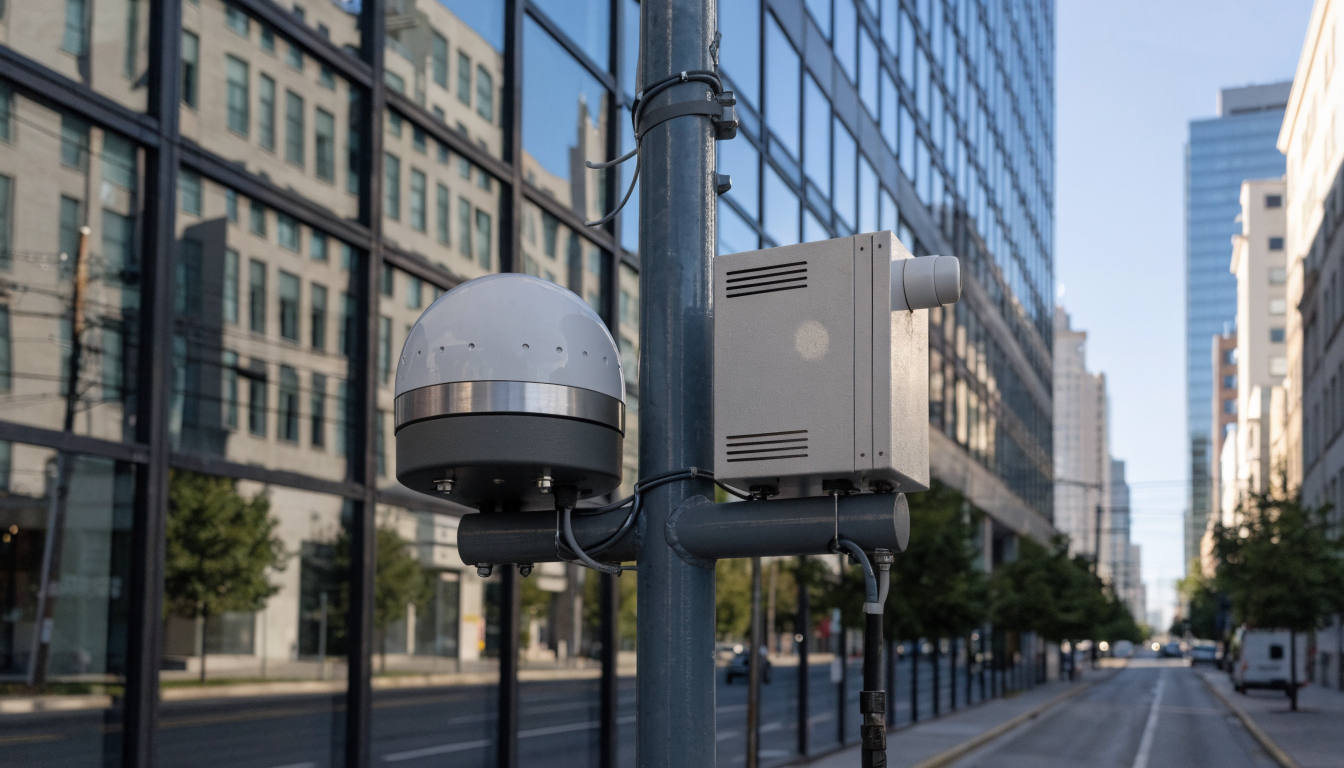
Key takeaways
- Compact weather stations now account for more than 20% of air quality monitoring system (AQMS) installations worldwide, because they combine several meteorological sensors into one housing.
- Five core weather parameters, temperature, humidity, pressure, wind direction and wind speed, directly influence how pollutants disperse, accumulate or get washed out of the air.
- Ultrasonic wind sensing and optical rainfall detection remove moving parts, which extends service life by 3 to 5 years compared with mechanical instruments.
- Data is typically sent over RS485, RS232, Zigbee, NB-IoT, LoRa, GPRS or LTE 4G, and units can run on solar power for unattended sites.
What an air quality monitoring system actually measures
An air quality monitoring system, or AQMS, is built to record two different kinds of data at the same time. The first is pollutant concentration: gases such as SO2, NOx, CO and O3, plus volatile organic compounds (VOCs), total hydrocarbons (THC), and particulate matter such as PM2.5 and PM10. The second is the weather itself. Pollutant readings on their own do not explain why a value spikes or falls, so most modern AQMS installations pair a gas and particle analyser with a dedicated weather sensor.
Why weather data is added to pollution monitoring
Weather does not just sit alongside pollution data, it explains it. A council or industrial site trying to understand a bad air day needs to know whether the cause was a genuine emissions increase or simply a change in wind, pressure or humidity that trapped existing pollution close to the ground. This is why compact weather stations have grown to represent a significant share, over 20%, of AQMS hardware deployed today. Reviewers of range-hood extractors do not care much about the weather. Environmental regulators do.
The five parameters a compact weather station covers
A standard compact weather station integrates five meteorological measurements into one unit:
- Atmospheric temperature
- Atmospheric humidity
- Atmospheric pressure
- Wind direction
- Wind speed
Many models can be specified with extra channels for solar radiation, rainfall, UV index (UVI), or an integrated camera, depending on the monitoring site's needs. MetSensor UK supplies the ZWS compact weather station range in the UK, and stocks several sizes within the ZWS series for sites with different mounting or power constraints. A full breakdown of the different models is available on the ZWS series comparison page.
How each parameter changes pollutant behaviour
Temperature and inversion layers
Temperature inversions occur when a layer of warm air sits above cooler air near the ground, which stops the normal upward mixing of the atmosphere. This traps pollutants close to the surface. Inversions are generally stronger in winter, which is one reason air quality often worsens during colder months.
Humidity and haze formation
High humidity, particularly in winter, encourages fog and haze to form. Moisture in the air allows fine particles to bind together and grow, which reduces visibility and raises measured particulate concentrations.
Wind speed and pollutant dispersal
Higher wind speeds disperse pollutants over a wider area, diluting local concentrations. Calm or still conditions do the opposite: pollutants stay close to their source and concentrations build up, which is why wind speed and wind direction are two of the most closely watched parameters at any monitoring site.
Precipitation as a natural cleaning process
Rain and snow physically remove polluted gases and particles from the air through dissolution and gravitational settling. A rainfall event often produces a visible, short-term drop in measured pollutant levels.
Pressure systems and stagnation
Low-pressure systems tend to encourage vertical mixing and diffusion, helping pollutants spread out. High-pressure systems, by contrast, are associated with stable, stagnant air that lets pollution build up over several days.
Installation, power and connectivity
One practical advantage of a compact weather station is speed of deployment. Because the sensors are pre-integrated into a single housing, installation can typically be completed in a few minutes rather than the hours needed to align, calibrate and wire several separate instruments. Power comes from either a solar panel and battery, suited to remote or off-grid sites, or a standard AC220V/DC12V supply where mains power is available.
On the data side, compact stations support a mix of transmission options: wired RS485 or RS232 for local logging, and wireless Zigbee, NB-IoT, LoRa, GPRS or LTE 4G for remote or distributed networks. Anyone integrating a station into an existing SCADA or Modbus-based system should read our explainer on how RS485 and Modbus communication works before specifying cabling and protocol converters.
Maintenance and durability
Older AQMS installations often relied on mechanical cup anemometers and tipping-bucket rain gauges, both of which have moving parts that wear out, jam with debris, or need periodic recalibration. Compact weather stations that use ultrasonic wind sensing and optical rainfall detection avoid this problem entirely. With no moving parts to service, these units are effectively maintenance-free and typically last 3 to 5 years longer in the field than their mechanical equivalents. For readers deciding between the two approaches, our guide comparing ultrasonic and cup anemometers covers the trade-offs in more detail.
Cost range
Compact weather stations for AQMS use span a wide price range, from several hundred pounds for a basic four or five-parameter unit up to around £1,500 to £2,000 for a fully specified station with radiation, rainfall and UV channels included.
Where compact weather stations fit in a wider monitoring network
A compact weather station is rarely the only sensor on site. In most air quality monitoring networks it works alongside dedicated gas and particulate sensors, and increasingly alongside drone-based or roadside monitoring equipment for a fuller picture of pollution sources and dispersal. Readers building a wider network can find background on adjacent applications on our air quality monitoring applications page. MetSensor UK is a UK distributor of our manufacturing partner weather and air quality sensors, and can advise on matching a compact weather station to an existing or planned AQMS deployment.
Frequently asked questions
What weather parameters matter most for air quality monitoring?+
Temperature, humidity, wind speed and direction, and atmospheric pressure are the core parameters, because each one affects how pollutants disperse or accumulate in the air.
How long does a compact weather station last compared to mechanical sensors?+
Compact stations using ultrasonic and optical sensing typically run 3 to 5 years longer than mechanical anemometers and rain gauges, because they have no moving parts to wear out.
How is a compact weather station powered and connected?+
Most units run on solar power or an AC220V/DC12V supply, and transmit data over RS485, RS232, Zigbee, NB-IoT, LoRa, GPRS or LTE 4G.